
Zowie External Agents
Overview
Zowie External Agents enable organizations to build custom AI agents or integrate existing ones using purpose-built SDKs, providing secure access to internal systems and expert services while maintaining complete observability through Supervisor—integrating seamlessly with Zowie's platform today via Decision Engine and tomorrow through Orchestrator Routing.
This powerful capability bridges the gap between your automation workflows and internal systems that cannot be exposed through public APIs, while giving you complete control over business logic, data, and infrastructure.
What are Zowie External Agents?
Zowie External Agents is a comprehensive solution for extending your AI capabilities beyond platform limitations. It provides:
- Purpose-built SDKs in Python and TypeScript/Node.js for building sophisticated agents
- Automatic Supervisor integration for complete observability without additional instrumentation
- Flexible platform integration through Decision Engine (available now) and Orchestrator Routing (coming soon)
- Enterprise-grade security with multiple authentication methods and compliance-ready audit trails
Unlike platform-locked solutions that force you into proprietary frameworks, Zowie External Agents provides development freedom with enterprise control.
Why Use External Agents?
External Agents are essential when your organization needs to:
Leverage Existing Investments
Connect agents you've already built, preserving your development efforts and domain expertise. The SDK wraps existing agents without requiring rewrites.
Build with Flexibility
Create new agents using familiar programming languages (Python or TypeScript/Node.js) and frameworks, not proprietary platforms. Implement business logic that requires code-level control.
Maintain Security Boundaries
Keep sensitive systems behind firewalls while enabling AI capabilities. Process data within your infrastructure to meet compliance requirements.
Unified Observability
Monitor all agents—internal and external—through Supervisor, providing a single pane of glass for operations. Every LLM call, API request, and routing decision is automatically tracked.
Platform Agnostic
Integrate with Decision Engine today and Orchestrator Routing tomorrow, future-proofing your agent architecture without code changes.
Core Capabilities
Zowie External Agents is built on three foundational pillars:
1. Development Freedom - External Agent SDK
The External Agent SDK provides purpose-built frameworks that empower developers to build sophisticated agents with complete control over business logic.
Multi-language Support
- Python SDK for data-intensive operations and ML integrations
- TypeScript/Node.js SDK for high-performance services
- Type-safe development with Pydantic (Python) and Zod (TypeScript)
Built-in LLM Integration
- Pre-configured clients for Google Gemini and OpenAI GPT models
- Automatic prompt construction with persona and context injection
- Structured output generation for type-safe data extraction
HTTP Client with Auto-tracking
- Connect to any internal API with automatic event logging
- Configurable timeout and retry logic
- Header and body filtering for sensitive data
Context Management
- Handle conversation history, metadata, and routing decisions seamlessly
- Maintain state across multiple agent interactions
- Preserve context between internal and external agents
2. Unified Observability - Supervisor Integration
Every external agent action is automatically tracked and visible in Supervisor, providing enterprise-grade monitoring without additional instrumentation.
Automatic Event Tracking
- LLM Calls: Model used, prompts, responses, and execution time
- API Calls: URLs, methods, headers (sanitized), request/response bodies, and latency
- Routing Decisions: Transfer logic, target blocks, and decision criteria
- Errors and Exceptions: Stack traces, error messages, and recovery actions
Performance Metrics
- Response time distributions
- Throughput and request volumes
- Error rates and types
- Resource utilization patterns
Compliance and Auditing
- Complete audit trails with timestamps and metadata
- User data handling tracked for privacy compliance
- System access patterns recorded for security audits
- Immutable logs for regulatory reporting
Zero Configuration Required
- No additional code needed
- Automatic event batching and transmission
- Resilient to network issues
- Minimal performance overhead
3. Flexible Integration - Platform Connectivity
External Agents integrate seamlessly with Zowie's platform, with support for multiple entry points.
Decision Engine Integration (Available Now)
- Delegate workflow control to external agents
- Conditional routing based on conversation context
- State management across multiple agents
- Automatic fallback handling on agent failure
Orchestrator Routing (Coming Soon)
- Direct routing to external agents without Decision Engine
- Dynamic agent selection based on capabilities
- Load balancing across multiple instances
- Priority handling for specialized routing
Enterprise Security
- Multiple authentication methods: Bearer Token, API Key, Basic Auth
- TLS encryption for all communications
- IP whitelisting and rate limiting support
- Configurable timeout and failure handling
External Agent SDK
The External Agent SDK is the cornerstone of Zowie's external agent strategy, providing developers with powerful, production-ready frameworks.
Available SDKs
Python SDK
Perfect for data-intensive operations, machine learning integrations, and teams with Python expertise.
Key Features:
- Built on FastAPI for high-performance async operations
- Full Pydantic v2 support for request/response validation
- Thread pool execution with configurable workers
- Compatible with pip, Poetry, and uv package managers
Links:
TypeScript/Node.js SDK
Ideal for high-performance services and teams working in JavaScript ecosystems.
Key Features:
- Express-based with TypeScript-first design
- Zod schemas for runtime validation
- Native async/await patterns throughout
- Compatible with npm, pnpm, and yarn package managers
Links:
Core SDK Features
Intelligent Context Management
- Automatic conversation history handling
- Metadata preservation across interactions
- Seamless state management between agents
LLM Provider Integration
- Pre-configured clients for Google Gemini and OpenAI GPT
- Automatic prompt construction with persona and context injection
- Structured output generation for type-safe responses
HTTP Client with Observability
- Automatic request/response logging to Supervisor
- Configurable timeout and retry logic
- Header and body filtering for sensitive data protection
Development Experience
- Comprehensive documentation and examples
- Built-in testing utilities and mocks
- Hot-reload support for rapid development
- Production-ready deployment configurations
Quick Start Examples
Python Example
from zowie_agent_sdk import Agent, Context, ContinueConversationResponse

class CustomAgent(Agent):
    def handle(self, context: Context):
        # Access conversation history
        messages = context.messages

        # Use built-in LLM client
        response = context.llm.generate_content(
            messages=messages,
            system_instruction="You are a helpful customer service agent."
        )

        # Return conversational response
        return ContinueConversationResponse(message=response)
TypeScript Example
import { Agent, Context, AgentResponse } from "@zowieteam/zowie-agent-sdk";

class CustomAgent extends Agent {
    async handle(context: Context): Promise<AgentResponse> {
        // Access conversation history
        const messages = context.messages;

        // Use built-in LLM client
        const response = await context.llm.generateContent(
            messages,
            "You are a helpful customer service agent."
        );

        // Return conversational response
        return { type: "continue", message: response };
    }
}
Integration with Decision Engine
The External Agent block enables your Decision Engine workflows to delegate control to external agents. This powerful feature bridges the gap between your automation flows and internal systems that cannot be exposed through public APIs, while maintaining full control over the conversation flow.
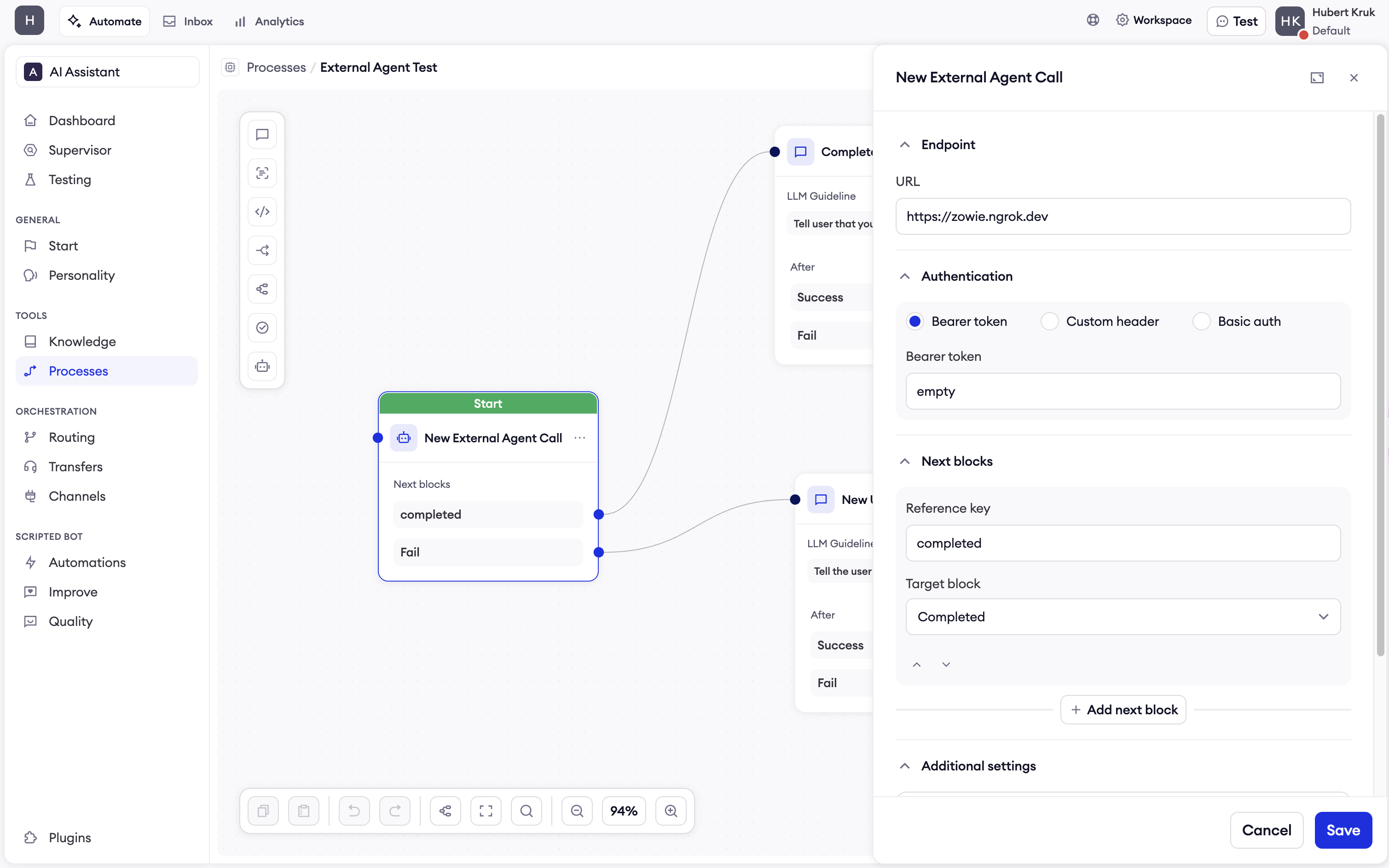
Note: This feature is currently behind a feature flag and may not be available to all users.
Core Purpose
The External Agent block solves a critical challenge in process automation: securely accessing internal expert systems and private data sources that cannot have public API exposure.
When your workflow reaches an External Agent block, it:
- Pauses execution and delegates control to your external agent
- Waits for the agent to process the request
- Routes the conversation based on the agent's response
This enables sophisticated integrations while keeping sensitive systems protected behind your firewall.
Configuration
Configure your External Agent block by setting up each section in the order they appear:
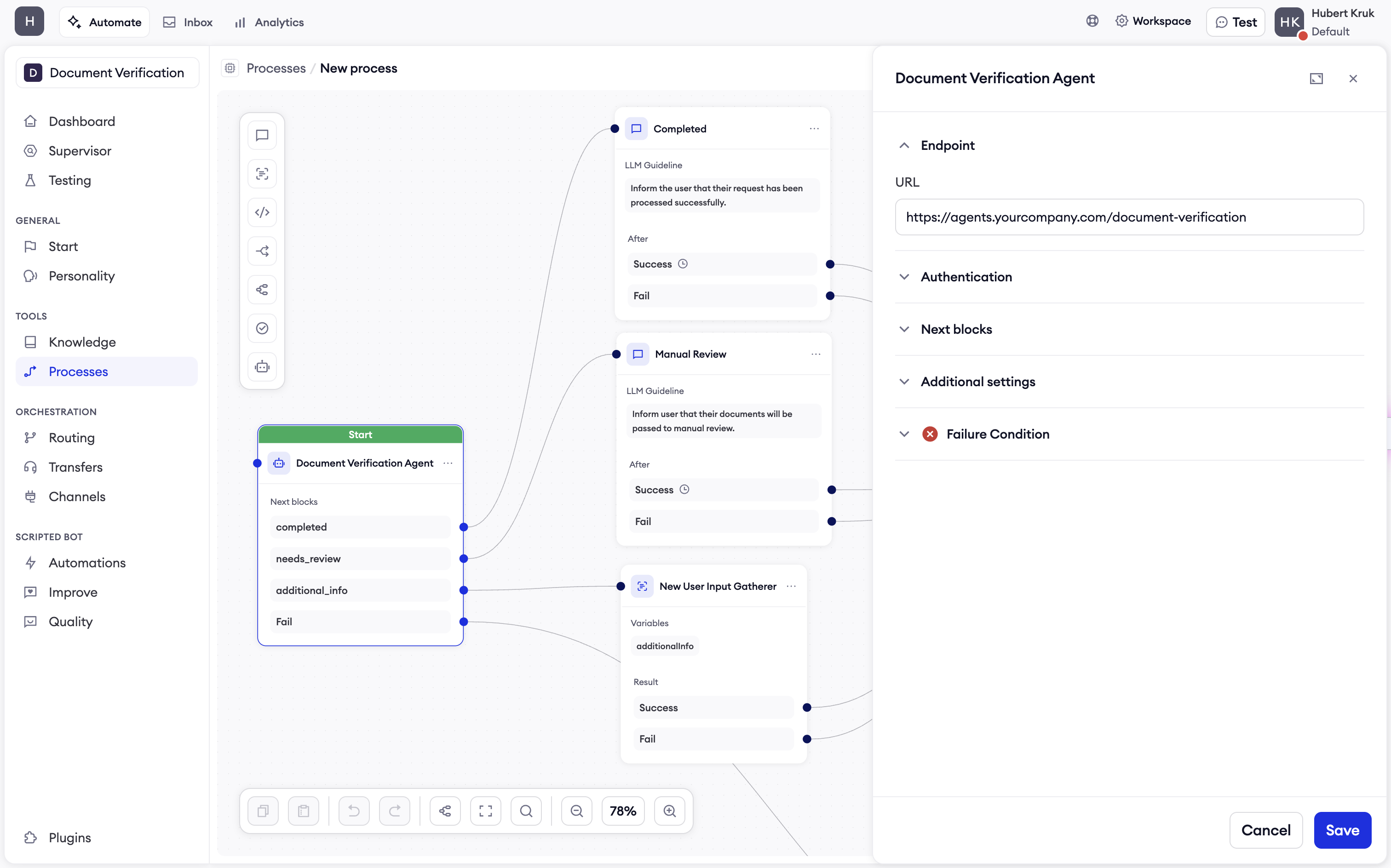
Endpoint
URL: Enter the full URL where your external agent is hosted
- Example:
https://agents.yourcompany.com/document-verification - Must be accessible from your Decision Engine instance
- Use HTTPS for production environments
Authentication Methods
Select and configure one of three authentication methods to secure the connection:
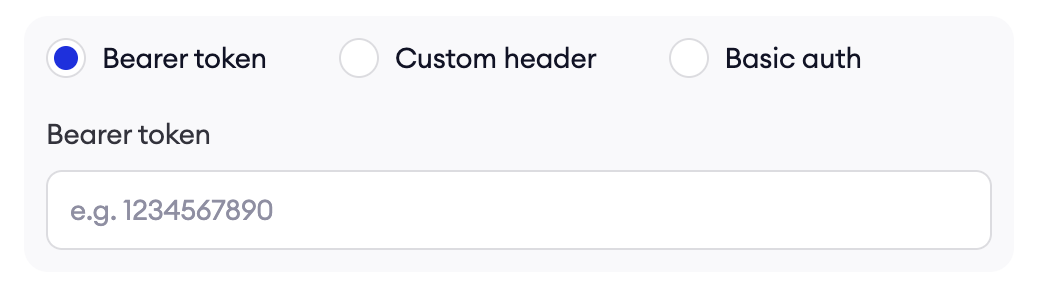
1. Bearer Token
- Enter the token value that will be sent in the Authorization header
- Example token: abc123xyz
- Your agent will receive:
Authorization: Bearer abc123xyz
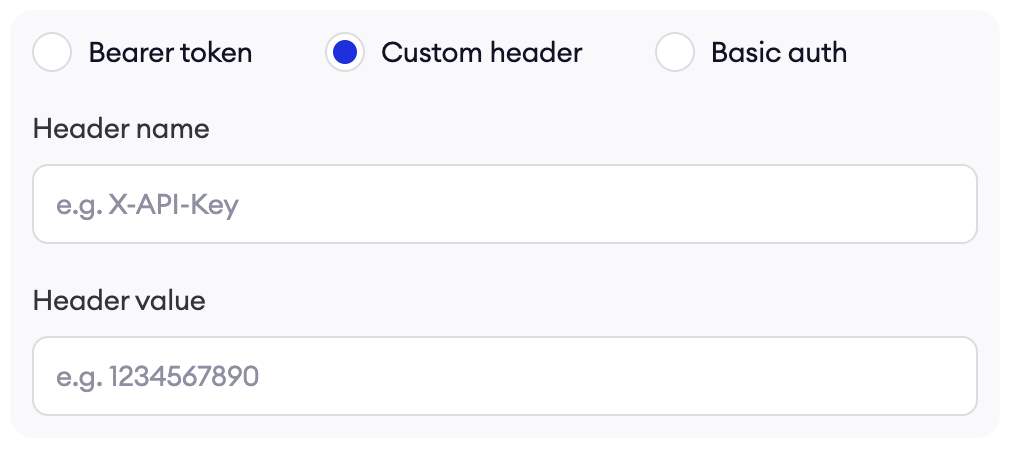
2. Custom Header
- Specify the header name (e.g.,
X-API-Key) - Enter the header value (e.g.,
your-secret-key) - Useful for proprietary authentication schemes
3. Basic Auth
- Enter the username
- Enter the password
- Credentials are base64 encoded automatically
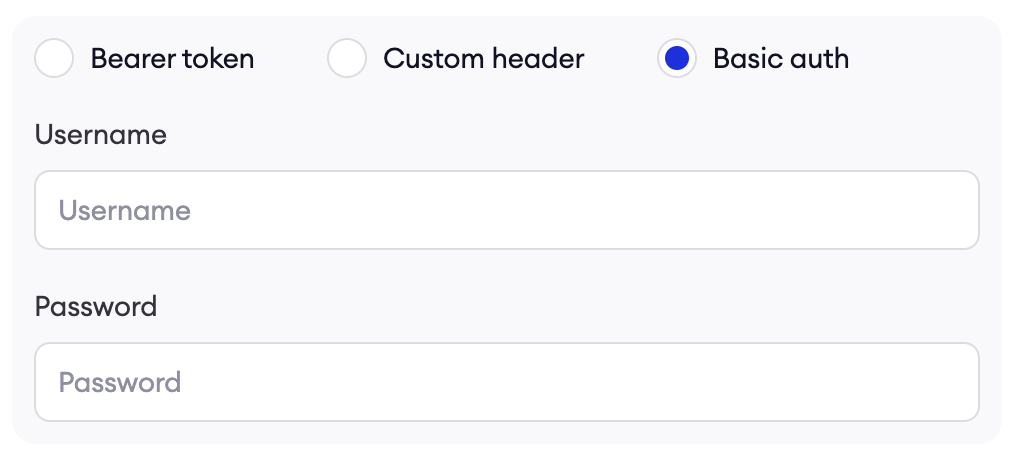
Choose the authentication method that best aligns with your external agent's security requirements and existing infrastructure.
Routing
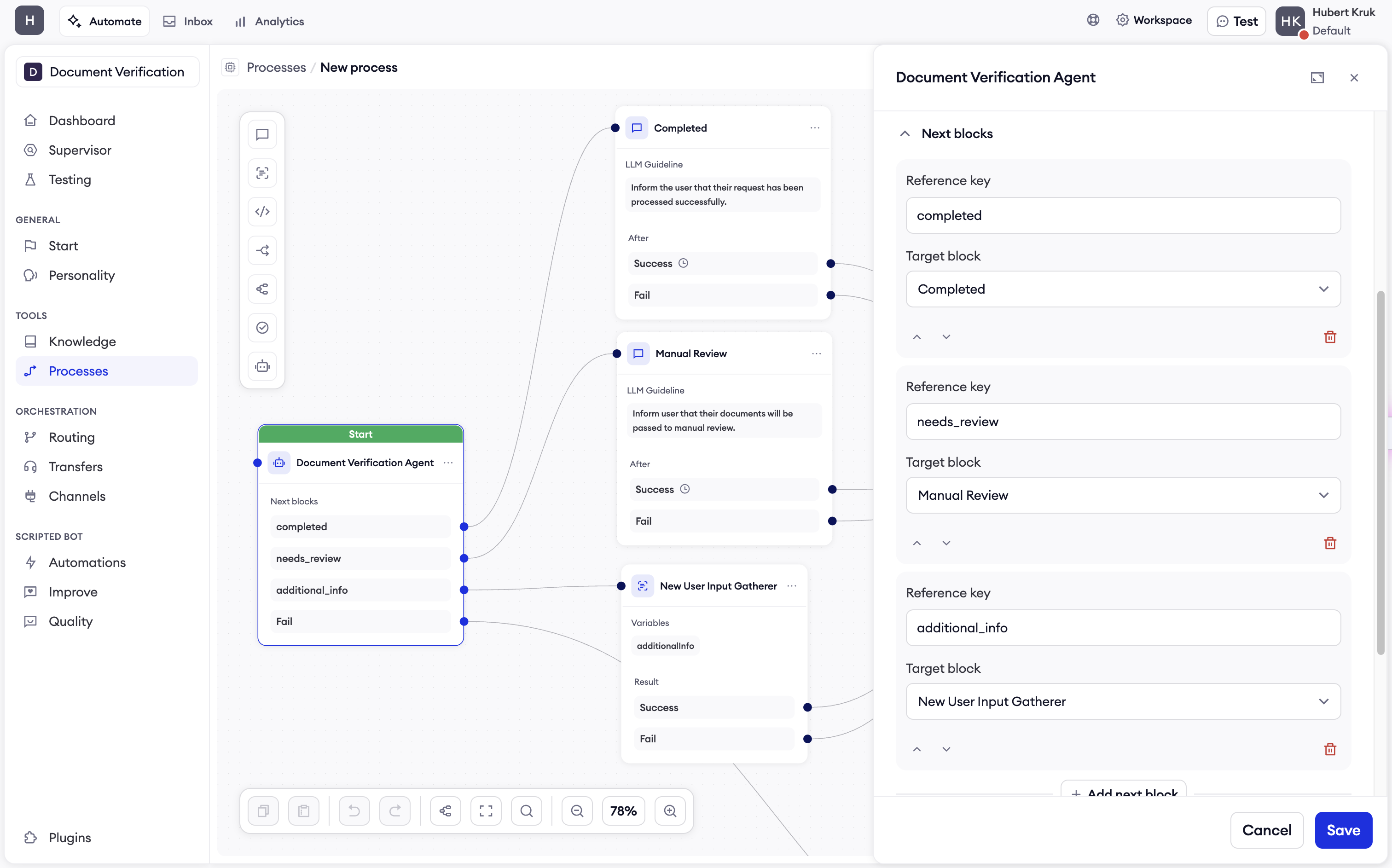
The External Agent block supports multiple routing paths based on response keys:
- Dynamic Routing: Uses reference keys returned by the external agent to determine the next workflow block. You can define multiple reference key/target block pairs, allowing for flexible branching based on the agent's response
- Failure Path: Activated when the agent encounters an error or cannot process the request
The routing decision is made based on the key value returned by the external agent, allowing for sophisticated branching logic within your processes.
Next Blocks
Configure the dynamic routing based on reference keys returned by your agent:
Reference Key: The key your agent returns to trigger this route
- Example:
completed,needs_review,documents_missing
Target Block: The process block to route to when this key is received
- Select from your available workflow blocks
Click "Add next block" to configure multiple routing paths. Each reference key should map to a specific scenario your agent handles.
Additional Settings
Provide context to external agent (Optional)
- Toggle this on to send additional context to your agent
- Enter context information in the text field that appears
- This context is sent with every request to help your agent make decisions
- Example: Business rules, specific instructions
Failure Condition
Target Block: Select the block to route to when the agent fails
- Handles timeouts, errors, or when the agent is unreachable
- Always configure this to ensure your workflow can recover gracefully
- Example: Route to
Error HandlerorManual Reviewblock
This failure path is triggered when:
- The agent doesn't respond within the timeout period
- The agent returns an error status
- Network connectivity issues occur
- The agent response cannot be parsed
Supervisor Integration
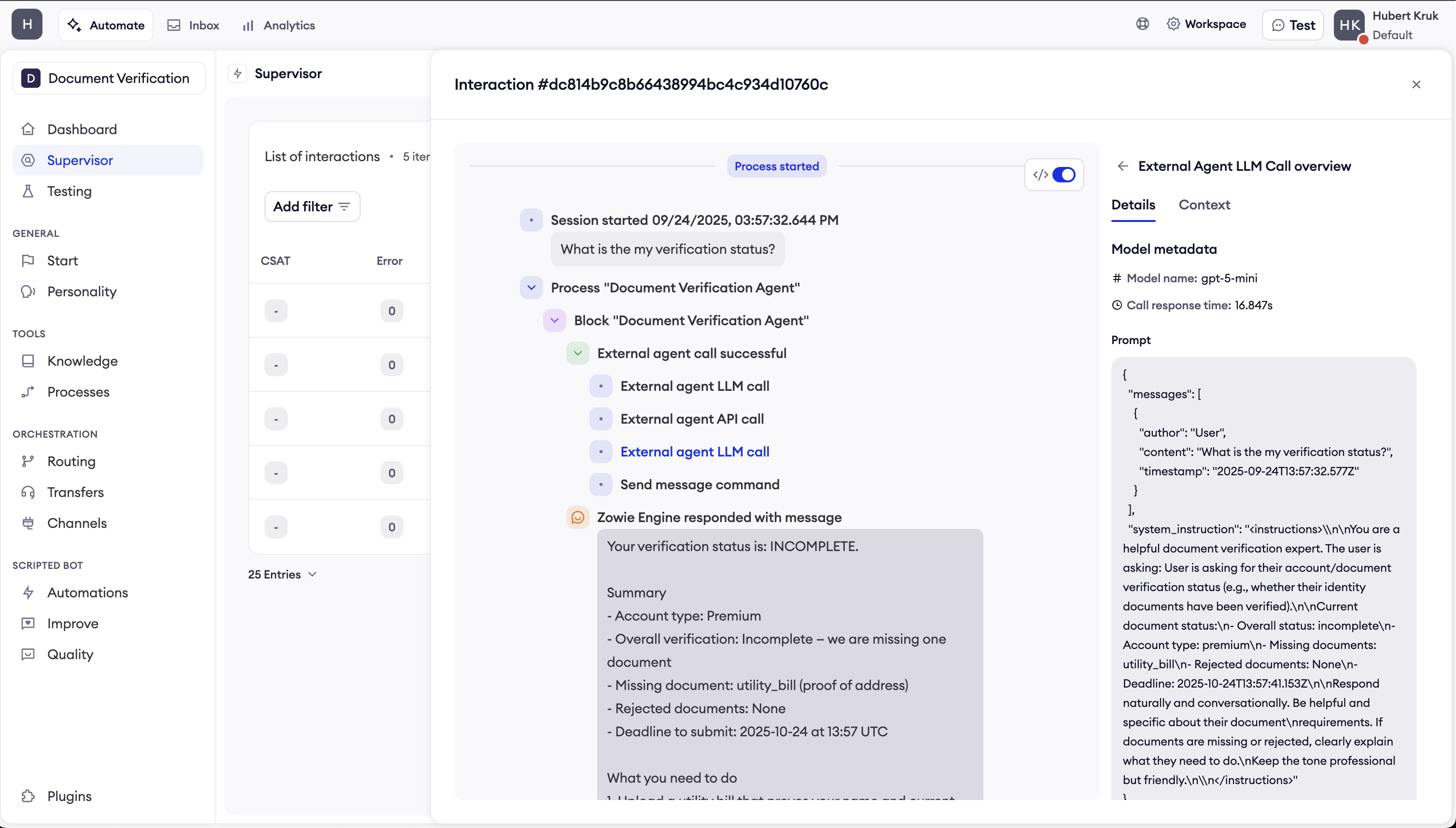
One of the most powerful aspects of Zowie External Agents is the automatic integration with Supervisor, providing complete observability for all external agent activities.
Unified Monitoring
External agents appear alongside internal Zowie agents in Supervisor, creating a single pane of glass for all AI operations.
What Gets Tracked Automatically:
- Every LLM call with model, prompts, responses, and execution time
- Every API call with URLs, methods, sanitized headers, bodies, and latency
- All routing decisions with transfer logic and target blocks
- Errors and exceptions with stack traces and recovery actions
Performance Visibility:
- Real-time response time distributions
- Throughput and request volume metrics
- Error rates categorized by type
- Resource utilization patterns
Conversation Flow Visualization:
- Complete conversation timeline
- Agent handoff points between internal and external agents
- Decision branches and routing logic
- User interaction patterns
Event Monitoring
When an external agent takes control:
- The event automatically appears as "deferred" in the Supervisor
- You can monitor processing time and identify bottlenecks
- Full audit trail is maintained for compliance
- Real-time log streaming during development
Operational Benefits
Debugging and Troubleshooting:
- Real-time log streaming during development
- Historical analysis for incident investigation
- Correlation between multiple agent interactions
- Performance bottleneck identification
Cost Optimization:
- Track LLM token usage across all agents
- Identify expensive operations and optimize
- Analyze prompt strategies based on actual usage
- Budget tracking and forecasting
Key Use Cases
Internal System Integration
Connect to proprietary databases, legacy systems, or sensitive internal services that must remain private. Your external agent acts as a secure bridge, processing requests and returning appropriate responses without exposing underlying systems.
Examples:
- Query customer data from internal CRM systems
- Access inventory management databases
- Integrate with legacy mainframe systems
- Connect to internal knowledge bases
Expert System Delegation
Leverage complex business logic or specialized knowledge bases that require developer expertise to maintain. External agents can make decisions based on intricate rules that would be difficult to implement directly in workflows.
Examples:
- Apply multi-step verification rules
- Implement dynamic pricing calculations
- Process complex eligibility requirements
- Execute specialized business workflows
Compliance & Security Requirements
Handle scenarios where regulatory or security constraints prevent direct API exposure. External agents can process sensitive data and return sanitized results appropriate for the conversation context.
Examples:
- Process PII data within infrastructure boundaries
- Apply industry-specific compliance rules (HIPAA, PCI-DSS)
- Maintain data sovereignty requirements
- Implement custom security protocols
Connect Existing Agents
Integrate agents you've already built in any language or framework. Preserve your development efforts and domain expertise while gaining Zowie platform capabilities.
Examples:
- Wrap existing Python ML models
- Integrate custom NLU services
- Connect proprietary AI systems
- Leverage existing automation investments
Real-World Example: Document Verification System
Consider a financial services company that needs to verify customer documents for account approval. Their verification system:
- Contains sensitive customer data that cannot be exposed publicly
- Uses complex business rules that vary by account type and jurisdiction
- Requires integration with multiple internal databases
- Must maintain complete audit trails for compliance
How It Works
1. Customer Request
Customer asks: "What documents do I need to provide?"
2. Workflow Delegation
Decision Engine routes to External Agent block, which sends the request to the document verification agent running in the company's secure infrastructure.
3. External Agent Processing
The agent:
- Queries internal customer database for account type
- Checks regional compliance requirements from private compliance system
- Evaluates previously submitted documents from document management system
- Applies complex business rules based on risk profile and jurisdiction
4. Intelligent Response
The agent returns:
- Reference key for routing (e.g.,
documents_required,verification_complete,manual_review_needed) - Conversational response explaining what documents are needed and why
- Metadata about the verification status for internal tracking
5. Workflow Continuation
Decision Engine routes to the appropriate next block based on the reference key, continuing the automation flow while maintaining context.
Benefits Realized
- Security maintained: Sensitive customer data never leaves internal systems
- Flexibility preserved: Complex business rules updated by developers as needed
- Full observability: Every database query and decision logged in Supervisor
- Compliance met: Complete audit trail for regulatory requirements
- Seamless experience: Customer receives intelligent, context-aware responses
How External Agents Respond
External agents built with the SDK can return two types of responses:
- Continuation response: Sends a message to the user and continues the conversation within the current workflow context
- Transfer response: Routes the conversation to a different block based on a reference key
The reference key returned by your agent must match one of the keys configured in your External Agent block's routing configuration (e.g., completed, needs_review, documents_missing).
For complete SDK documentation, code examples, and implementation guides for both response types, refer to the official SDK repositories on GitHub.
Questions & Answers
Q: How does the External Agent SDK differ from building agents from scratch?
A: The SDK provides production-ready frameworks with built-in LLM integration, automatic Supervisor observability, conversation management, and enterprise authentication. Building from scratch would require implementing all these capabilities yourself, taking months of development.
Q: Can I integrate agents I've already built?
A: Yes! The SDK is designed to wrap existing agents, adding Zowie platform integration and Supervisor visibility without requiring rewrites. Your existing business logic remains unchanged while gaining enterprise capabilities.
Q: What happens if an external agent fails or becomes unavailable?
A: The platform includes configurable timeout and failure handling. Failed requests automatically route to configured fallback blocks, ensuring conversation continuity. All failures are logged in Supervisor for troubleshooting.
Q: How do external agents access internal systems securely?
A: External agents run within your infrastructure, behind your firewall. They can access internal systems directly without exposing APIs externally. The SDK handles secure communication with Zowie's platform using your choice of authentication methods.
Q: Can external agents work with both Decision Engine and Orchestrator Routing?
A: Yes, agents built with the SDK are platform-agnostic. They work with Decision Engine today and will seamlessly integrate with Orchestrator Routing when available, protecting your development investment.
Q: What kind of agents are best suited for external development?
A: External agents are ideal for: specialized business logic, integration with internal systems, processing sensitive data, leveraging existing code bases, or any scenario requiring development flexibility beyond platform capabilities.
Updated 12 months ago